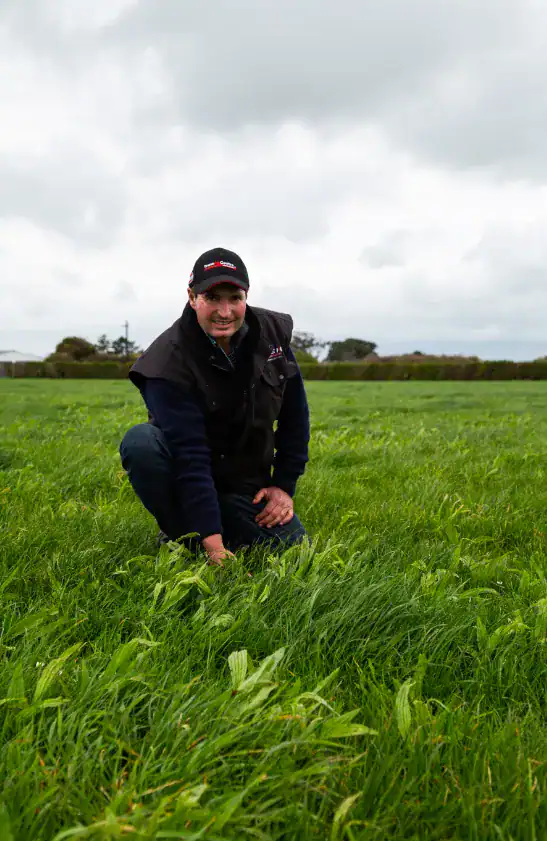
Allan Marx
Taranaki, New Zealand

For Allan Marx, the Tow and Fert was never going to be just a urea sprayer.
Allan farms at Mangatoki in Taranaki, fifth generation on the family farm, running crossbred Jerseys across 120 hectares on a simple pasture-based system. He came to farming from an engineering and mechanical background, and it shows in how he approaches things. He does not take much on faith.
“I’m not organic by any stretch of the imagination, but I do believe there are a lot of answers to be had outside of the conventional farming and chemical fertiliser spectrum.”
Before the Tow and Fert, Allan was applying all of his nitrogen as granular urea, and like a lot of farmers he was at the mercy of the weather to get value from it.
“Prior to having a Tow and Fert all my urea was spread as granular urea. We didn’t have any technology available to us to do any better than that, and we were always weather dependent.”
He had seen the machines at Fieldays, but what convinced him was talking to someone already using one. A mate in Southland was running one through a contractor, so Allan got him on the phone.
“I rang that contractor up and had a good yarn to him for about three quarters of an hour about what he could do and how it all worked, because I actually wanted to talk to somebody who had actually used it.”
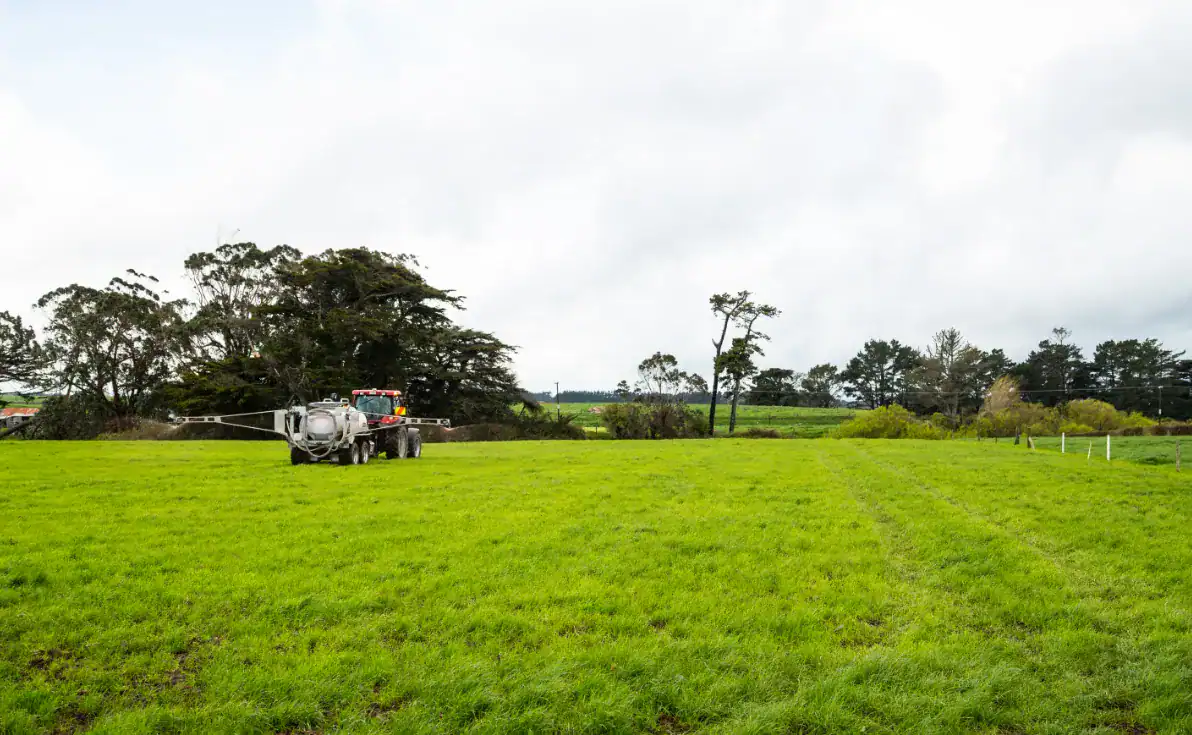
Satisfied it stacked up, he drove to Dannevirke to spec a Multi 4000 to his farm, and took delivery in September 2018. He knew exactly what he was after.
“I had a bit of an understanding as to what I wanted, and I wanted a machine that could do a lot of other things rather than just dissolve urea.”
What Allan sees in the paddock
Ask Allan what has changed and he talks about the grass, not the fertiliser bill. His farm is mostly tetraploid ryegrass, which is prone to opening up over time, and he has seen the opposite.
“We’ve got a lot greater plant density since we’ve been using the Tow and Fert. It’s as even as the pile on a carpet. There’s no thick patches, no thin patches, no urine spots. The palatability of the grass has just been amazing.”
The difference showed up again when the season turned dry.
“Last year we had quite a severe dry patch through here after Christmas, from January till mid to late March. This farm held on a heck of a lot better than others in the area. When the rains did come in late March, early April, the farm responded very quickly.”
He went looking for the reason with a spade.
“What was really evident was the root depth. We had ryegrass roots down well below the bottom of the spade depth, and we had lots and lots of worms. Grass pulling is becoming a bit of an issue with the industry, pastures pulling out when it gets dry and stressed, and that’s to do with root depth. That’s something we’re just not seeing a problem with.”
One pass, a whole programme
Thinking about Tow and Fert?
Talk with a specialist
Tell us about your operation and we’ll match the right model and setup for you.
The reason Allan wanted more than a urea sprayer is that he runs his entire soil programme through the one machine. On a single load he might carry lime flour, potash, humates, molasses, seaweed extract, trace elements including selenium and cobalt, fish hydrolysate, and urea, matched to what his soil and herbage tests are asking for. The molasses goes in every load.
“Molasses feeds the microbes in the ground. There’s actually more going on below the surface of the grass than there is above the surface. I’ve never done a single load yet without it.”
He applies his selenium a little at a time through the season rather than in one hit, because the timing suits the pasture better.
“The conventional method of putting selenium prills on doesn’t work real well, because you get a big spike in selenium levels in your pasture in the months immediately after that, and then it tapers off really severely. And that shows up in herbage tests.”
He also oversows through the same pass, and rates the result highly.
“This machine will hold six tonnes of payload, so 20 hectares in a load. No problems to chuck in 40 kg of chicory, 40 kg of plantain, 40 kg of red or white clover at the same time, mix it all up in the brew and away you go. There’s no extra labour, there’s no extra machinery costs, and the strike from the seed being broadcast out through a Tow and Fert is absolutely unbelievable. If you can dissolve it in a bucket of water you can put it in the Tow and Fert. It’s really that simple.”
Allan is also honest that there was a learning curve, and he is quick to own it.
“It hasn’t been completely without its trials and tribulations, and most of them have been operator error or operator misfortune. It is a new piece of gear, and very different from a conventional fertiliser spreader. But there are some simple procedures to follow. Most of the problems I have encountered have been self-inflicted, and that is the nature of the beast.”
Eighteen months on, he had settled into a programme and was seeing it in the soil.
“We have an awesome clover cover and plant health. The clover is prolific. My soil health is getting better and better. I have a massive worm population, and we are seeing increasing levels of good bacteria and fungi. Basically our soil is just coming alive. I’ve got increasing soil K, so this season I am able to back off on the application of K. I’ve never used so little.”
On the cost of it, Allan is clear that the saving is real, and it is his own figure off his own farm. Before the Tow and Fert his urea had peaked at between 170 and 180 units a year.
“Once you factor in the additional products I now use, I am still saving around 25%, or around $30,000 a year. So it is significant, and that is before any spreading costs.”g in fertiliser. Within a year I’ve got extra cash in the bank, effectively. By the time it’s paid off, another year’s time, I’ll be winning out totally without a finance bill. The saving on the contractor alone would have pretty much paid for it.”